
- Privacy Policy
- Cookie Policy
- Faqs
- Careers
©MoonlightDesign Ltd
©MoonlightDesign Ltd
Oct 25, 2026 . 10 min
read
Written by David Haslehurst
For the inside of your home, a lighting designer is almost a must. Your electrician installs the lights safely and to regulations, but deciding what the lighting should do in every room is a different skill, and the earlier you involve a designer the better. The same applies to your garden and exterior if you want to enjoy it after dark. Only for a simple room where you just need working lights can a good electrician manage without one.
The two jobs sound similar, and they are regularly confused, but the gap between them is usually the difference between a home that looks and feels right after dark and one that is simply lit.
We have been designing lighting since 2003, and we have our own team of electricians for garden and exterior schemes, so we see both sides of this every week. This article explains what each role does, where the overlap ends, and why timing matters more than almost anything else.
Let us be clear about this first, because it is not a criticism. A qualified electrician is responsible for the safety and compliance of everything electrical in your home. They size the cables, plan the circuits, install the consumer unit, test the installation and sign it off. On a renovation or a new build they are juggling sockets, heating, data, extraction, the kitchen appliances and the lighting all at once, often under pressure from a programme that is already slipping.
When it comes to lighting, an electrician will typically ask you where you want the lights, or offer to lay them out in a sensible grid. Both are reasonable responses from someone whose job is to install and certify. What neither does is answer the real question, which is what the light is supposed to do in each space.
A lighting designer starts from the other end. Before anyone thinks about cables, the designer looks at how the room is used, what it is made of, where the daylight comes from, what you want to see and what you want to hide. Then they work out how to achieve that with light. The positions of the fittings come last, as a result of those decisions rather than a starting point.
In practice that means a lighting designer is thinking about:
Every one of those decisions is then recorded in a CAD plan, a specification and a lighting specification list, so your electrician has a document to install from rather than a conversation to remember. That is the handover between the two roles. The designer decides, the electrician builds.
Lighting inside a home is different from almost any other part of a project. Every room needs more than one layer of light. The cables sit inside the walls and ceilings. The fittings are built into plasterboard, joinery and floors. And you live with the result every day, in every room, from breakfast to bedtime. A scheme that is slightly wrong is not a minor flaw you can ignore, because you see it every evening.
That is why, for the interior of a new build, extension or renovation, we would say a lighting designer is almost a must. Outside, a designed scheme turns a garden into somewhere you can use and enjoy after dark, and it is worth having for the same reasons. But if you are choosing where a lighting design matters most, start with the rooms you use every day.
If you take one thing from this article, take this: the value of a lighting designer falls sharply with every week that the building work progresses.
Lighting lives in the fabric of the building. The cables run inside the walls and ceilings. The fittings sit in the plasterboard, the joinery, the floor and the garden paving. Once those surfaces are finished, every change becomes a repair. A fitting that could have been positioned anywhere at the drawing stage can only go where there is already a cable once the ceiling is up.
The ideal moment to bring in a lighting designer is when you have architect's drawings and before first fix. At that point:
Bring a designer in after first fix and much of this is already fixed. Bring one in after plastering and you are choosing between living with compromises or paying to undo finished work. We can and do help at every stage, but we would rather you had the best result, and the best result comes from starting early. If you have just appointed an architect, or you are about to instruct a builder, now is the time to talk to us.
It is easy to talk about lighting in the abstract. Here is what the absence of a design looks like in a real home.
The kitchen has a neat grid of twelve downlights. The island is between two rows, so it is in shadow. The worktop along the wall is in the shadow of the wall units because the downlights are in the centre of the room. Someone standing at the hob casts their own shadow over the pan. The dining table at the far end has a downlight straight over one chair, so whoever sits there eats under a spotlight. The whole room is on one switch, so it is either fully bright or off. In the evening, with the family trying to relax, it feels like an office.
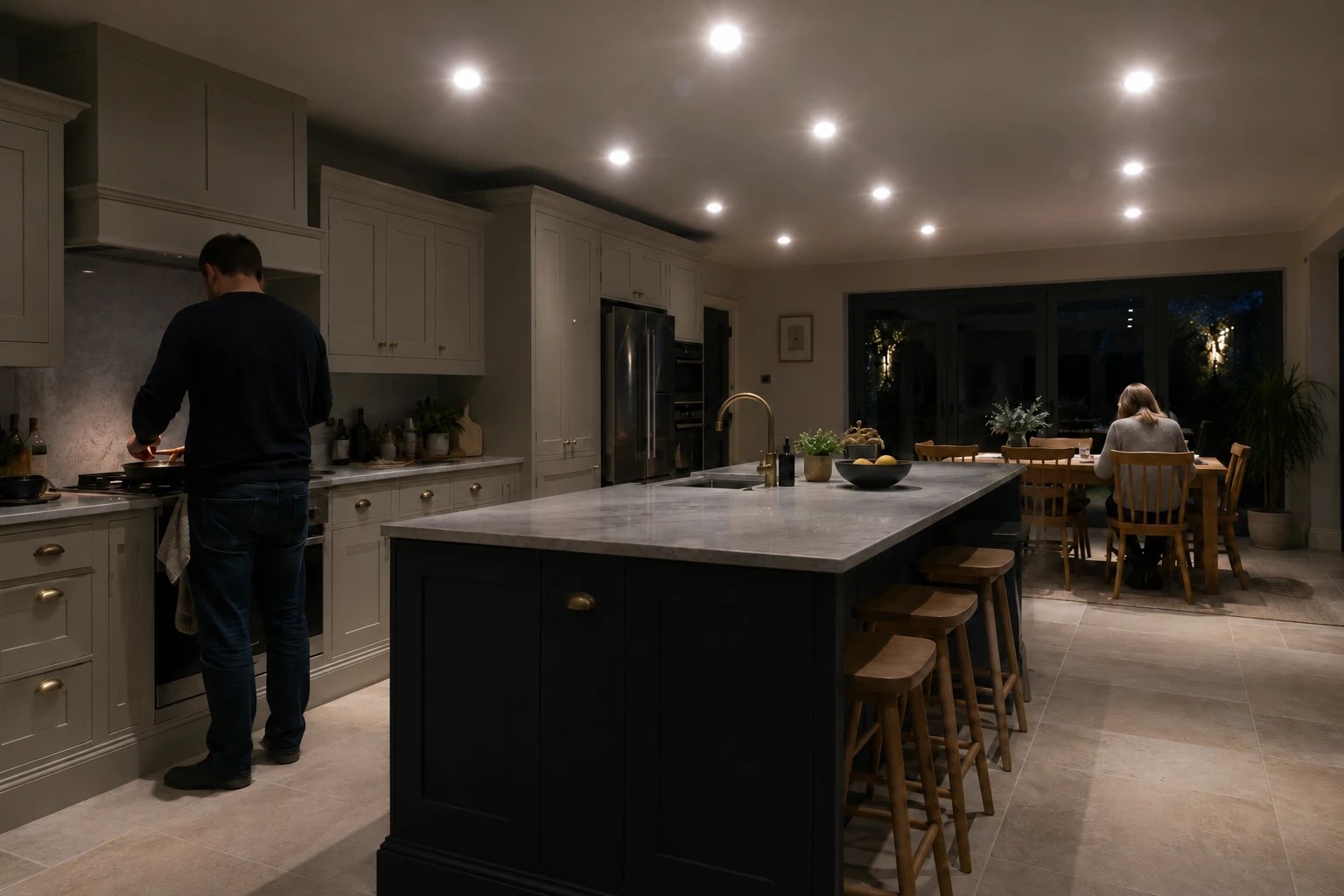
None of that is the electrician's fault. They installed a safe, compliant, well made grid, exactly as discussed. The problem is that nobody designed it. A lighting designer would have put light on the island and the worktops, kept it off the seats, separated the circuits so the room could change mood, and specified fittings that do not glare. Same budget, often fewer fittings, a completely different room.
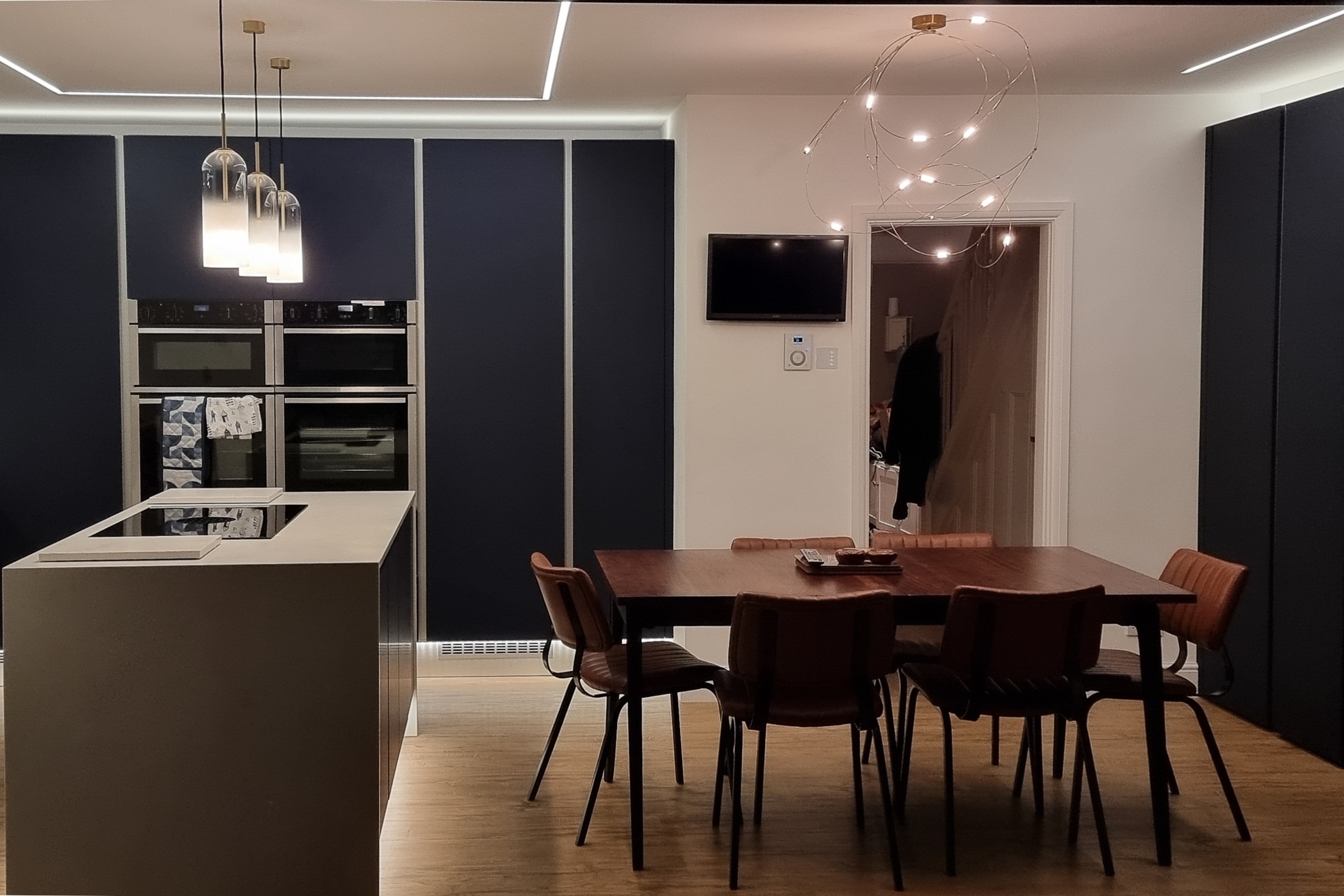
Outside, the equivalent is the garden with a floodlight on the back wall. It lights the patio, blinds everyone sitting on it, and makes the rest of the garden disappear into blackness. A designed scheme would uplight the trees, graze the walls, mark the steps and leave the floodlight for the security camera.
If you decide to use a lighting designer, it is worth asking who you are actually getting. The title is not protected, and most people working as lighting designers in this country have come from an interior design or architecture background and are not qualified in lighting design itself.
Our head of design, Alissa Fiordelmondo, graduated as a lighting designer from the Accademia di Belle Arti in Macerata, Italy, and has led our design studio since 2018. A formal qualification in lighting design is still rare in this country, and it means our schemes start from the principles of how light behaves in a space, not from a catalogue. It is no accident that so many of the best lighting designers are Italian: Italy has treated light as a design discipline for generations, and the training reflects it. Alissa works alongside David, who founded Moonlight Design in 2003 and has over 26 years of experience as a lighting designer, and Phil Jackson, our technical director, who has worked in the lighting trade for more than 40 years and oversees our installations.
That combination of a qualified designer, decades of hands on experience and an in house installation team is unusual. It means the person drawing the scheme knows how it will be built, and the person building it understands why it was drawn that way. We are an award winning practice. Our own work received a German Design Award in 2021, and we were part of the team behind the Residential Project over £500K winner at the FutureScape Global Awards 2025. Our work has been featured on BBC, ITV and Channel 4, and in The Sunday Times, the Financial Times, The Daily Telegraph, Elle Decoration and House Beautiful, and our projects include Glyndebourne, Dulwich College and the Hackett flagship store on Regent Street, alongside a great many private homes and gardens. You can browse a selection on our projects page.
You do not need a lighting designer to have working lights. For the interior of your home we would say you almost always do need one if you want the lighting to make the most of the home you are spending a great deal of money on, and the same goes for a garden you want to use after dark.
If you are:
then a lighting design is one of the best value decisions in the project. Our design fees are explained in detail in our guide to how much a lighting design costs in the UK, and in almost every case the fee is smaller than the cost of a single round of remedial work.
We are not here to replace your electrician. For interior, commercial and architectural projects, our role is to produce the lighting design: the CAD plan, the specification and the lighting specification list. Your electrician installs from it, and we are on hand to answer their questions. If you would like us to source and supply the fittings so there is one lighting specification list and one point of contact, we can do that as a separate service, and we can quote to install any project if you would rather we did.
For residential garden and exterior lighting, we usually design, supply and install the scheme ourselves with our own specialist exterior electricians. Outdoor work has its own demands around cabling, waterproofing, planting and longevity, and having the designer and installer in the same team means the garden you were shown on the drawing is the garden you get.
Some electricians have a good eye and plenty of experience, and for a simple space that may be enough. Their training is about installing safely and to regulations, while lighting design is a separate specialism, and the two roles work best together. For anything you care about, a specialist design gives your electrician a clear plan to build from, and a better result.
For the inside of your home we would say a lighting designer is almost a must, because every room needs several layers of light and the cables are built into the structure. A garden benefits from a designer for the same reasons, and the best results come from designing inside and out together.
As soon as you have drawings and before first fix. The earlier the better. A design done at the planning stage costs no more than one done later and avoids compromises that cannot be undone once the walls and ceilings are closed.
Rarely too late, but the options narrow as the work progresses. Contact us anyway and we will tell you honestly what can still be improved.
No. The design is an independent service. You can buy the specified fittings from us, from another supplier, or through your electrician.
Yes. We are based in London, and we design lighting for homes, gardens and commercial projects across the UK and overseas. We install all over the UK and abroad, so where your project is makes no difference.
There is no legal requirement, which is why it is worth asking. A formal lighting design qualification, a portfolio of completed projects you can visit or see photographed, and the ability to produce a proper CAD plan and specification are the things to look for. Our head of design graduated in lighting design, which remains unusual in the UK.
If you are planning a project and want to know whether a lighting design would help, get in touch. A short conversation at the right moment can save a great deal of disappointment later.

