
- Privacy Policy
- Cookie Policy
- Faqs
- Careers
©MoonlightDesign Ltd
©MoonlightDesign Ltd
May 29, 2025 . 7 min
read
Written by David Haslehurst
Lighting shapes how a home looks and feels, indoors and out. LED has become the default choice for almost every new lighting scheme, and for good reasons: it costs far less to run, it lasts much longer, and it gives a designer far more control over how light behaves. But not all LED lighting is the same. The benefits only appear when the right fittings, drivers and controls are chosen to work together.
This guide explains what LED lighting is, what the real benefits are, what separates a good LED scheme from a poor one, and where LEDs work best inside and outside the home.
LED stands for light-emitting diode. An LED is a small semiconductor chip that gives off light when electricity passes through it, rather than by heating a filament as a traditional bulb does.
A complete LED light needs two more things: a driver, which converts mains power into the steady, low-voltage current the chip needs, and a way of drawing heat away from the chip, usually a metal heat sink. The chip, the driver and the heat management together decide how bright, how consistent and how long-lived a fitting turns out to be.
Compared with the halogen lamps they replace, LEDs typically use around 80% less energy for the same brightness. Over the many hours a kitchen, hallway or garden scheme is switched on each year, that adds up. It also reduces the carbon emissions linked to the electricity you use.
The Energy Saving Trust gives around 2,000 hours for a halogen bulb and 10,000 hours or more for an LED bulb. Good LED fittings from established manufacturers are commonly rated for 25,000 to 50,000 hours, which is many years of normal use. Fewer replacements mean lower costs, less maintenance (particularly useful for fittings in high ceilings or set into the ground) and less waste.
LEDs can be dimmed to a soft glow and are available in a range of colour temperatures, from warm white for living spaces to cooler white for work areas. With the right controls, a scheme can change from bright and practical to calm and relaxed at the touch of a button.
A tiny chip means slim downlights, thin strips that tuck into a shelf or a ceiling recess, and fittings small enough to disappear into a wall or a paved step. This lets a designer show the effect of the light rather than the fitting.
LEDs give off far less radiant heat than halogens, so they are more comfortable to be near and gentler on fabrics and artwork. They still produce heat at the chip, which is why good heat management matters. LEDs also contain no mercury, unlike fluorescent tubes and compact fluorescent lamps, but they should still be recycled as electrical waste at the end of their life.
LEDs reach full brightness immediately, even in cold weather, and they are far less fragile than filament lamps. Outdoors, reliability depends on the fitting being built for the conditions, which is where the IP rating comes in (see below).
Colour temperature is measured in kelvin (K). Warm white, around 2700K to 3000K, suits most homes. Cooler white, around 4000K, suits workspaces. The most common mistake is mixing different colour temperatures in one space, which makes a room look patchy. A designer chooses one and keeps to it.
CRI is a score out of 100 for how truthfully a light shows colours. For homes, food, artwork and skin tones we look for a CRI of 90 or higher. Cheaper LEDs often score lower, which can leave woods, fabrics and food looking dull.
A small, bright source can dazzle. Deeply recessed fittings, anti-glare optics and the right beam angle keep the light on the surface you want lit and out of your eyes.
The driver and the dimmer must be compatible. A mismatch is one of the most common reasons an LED scheme flickers, buzzes or will not dim smoothly. Specifying the fittings, drivers and controls together avoids the problem.
Watts tell you how much power a light uses. Lumens tell you how much light it gives out. With LEDs, compare lumens.
The IP rating shows how well a fitting is protected against dust and water. IP65 copes with rain and jets of water and suits most fittings in an open garden. IP67 survives temporary immersion and suits fittings at ground level that may sit in puddles. IP68 is for continuous submersion. Drivers and connections need protecting too, not just the fitting.
Lighting in or very close to water is specialist work. It needs correctly rated fittings, a safe low-voltage supply and a qualified electrician.
LED strip lights can be hidden under shelves, behind mirrors, in ceiling recesses or along stairs, adding safety and atmosphere. A diffuser over the strip stops the individual dots of light showing. Downlights give general light and, when adjustable, can wash a wall or pick out a piece of art. Light under kitchen units improves worktop tasks, as we explain in our guide to kitchen lighting design. In offices, LED panels replace large fluorescent fittings with a slim, even light. Dimming lets the same room work for reading, cooking or relaxing.
Our interior lighting design service shows how these layers work together.
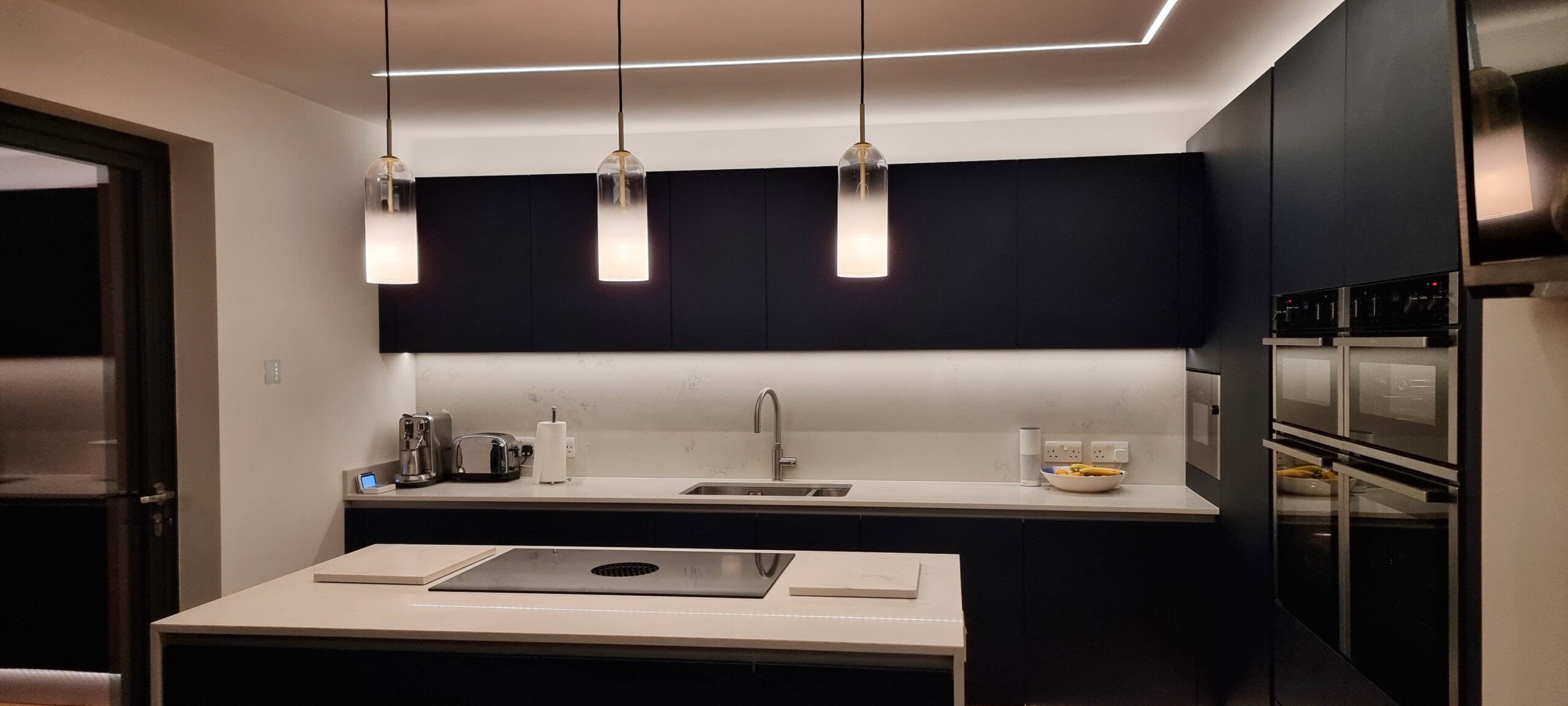
This table sets out common LED fittings, where they are used and what to check before choosing them.
| Fitting | Typical use | What to check |
|---|---|---|
| LED downlight | General and accent light from the ceiling | Glare control, beam angle, CRI |
| LED strip | Under units, shelves, ceiling recesses, stairs | Diffuser, driver capacity, dimming, CRI |
| LED panel | Offices and commercial ceilings | Glare, colour temperature |
| LED spotlight | Artwork and feature walls | Beam angle, CRI, adjustability |
| LED bollard | Paths and driveways | IP rating, glare, warm colour |
| LED uplight | Trees and planting | IP rating, ground-level protection, beam angle |
Outdoors, LED bollards light paths and driveways using very little energy, and wall lights by the front door make an entrance both welcoming and safer. Uplights bring out the shape of a mature tree, step lights make changes of level easy to read at night, and LED strip set into a planter or wall edge can mark a path without any visible fitting. Our exterior lighting design service covers all of these, and our guide to lighting your garden has more ideas.
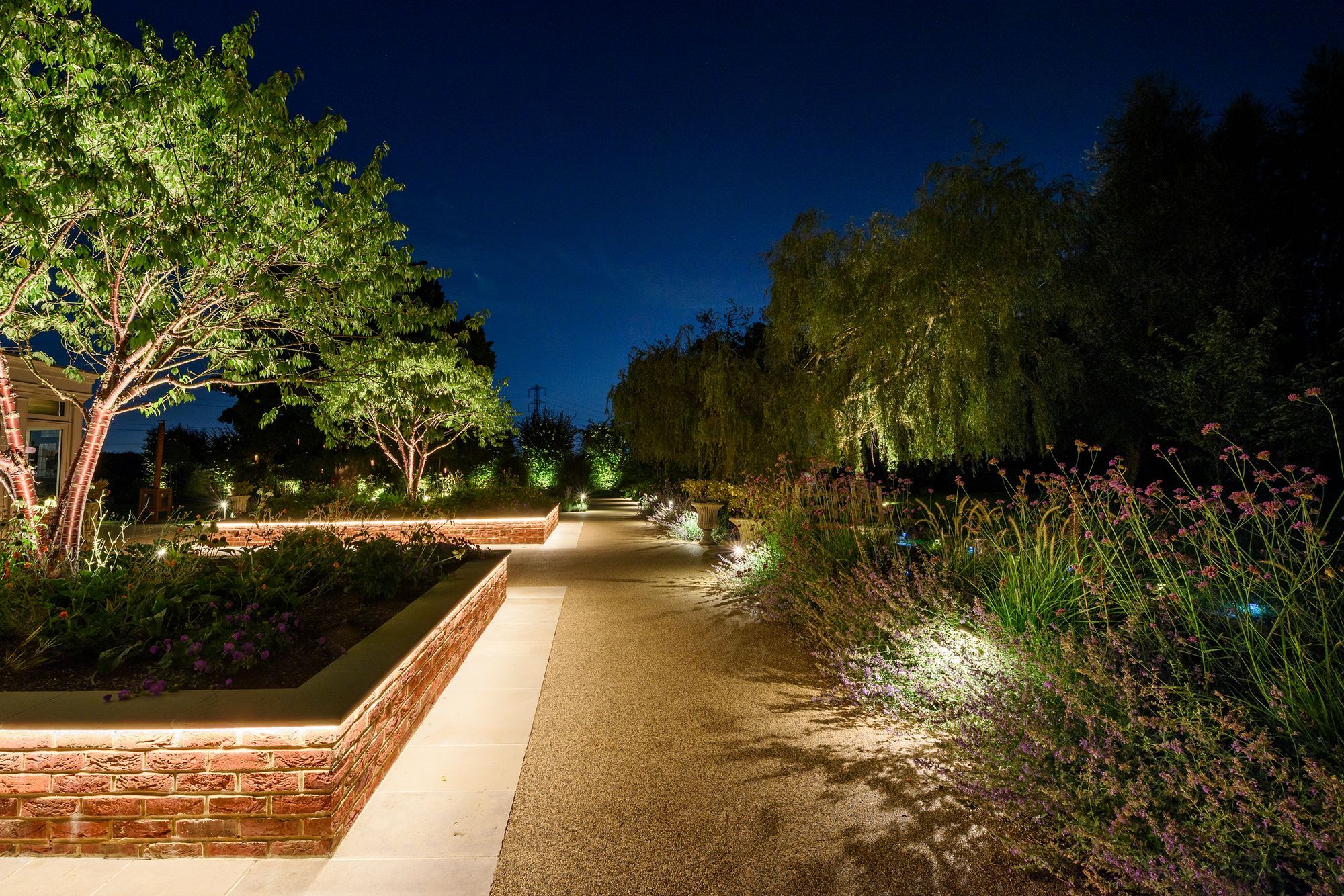
Outdoor schemes are usually low voltage, with fittings rated for the position they sit in (see IP ratings above) and controlled by timers, dusk sensors or switching zones, so light is only on where and when it is needed. Warm white light also tends to be gentler on wildlife than cool white, and we look at the balance in our guide to garden lights and wildlife.
LED is already the standard. Most halogen bulbs have been withdrawn from sale in Great Britain in stages since September 2021, and LED technology keeps improving in efficiency, colour quality and control. The real difference in the future will be how well LED is designed: layering light for different tasks, choosing quality fittings and planning the controls. A poorly designed LED scheme can be glaring, flat or short-lived. A well-designed one is comfortable, efficient and lasts for years.
Yes. LEDs typically use around 80% less energy than the halogen lamps they replace, and they last far longer, so you spend less on both electricity and replacements.
The Energy Saving Trust gives 10,000 hours or more for an LED bulb. Quality LED fittings are commonly rated for 25,000 to 50,000 hours, depending on the fitting and how well it manages heat.
Yes, and they dim smoothly when the fitting, driver and dimmer are compatible. A mismatch can cause flicker or buzzing, so it is best to specify them together.
Most homes suit warm white, around 2700K to 3000K. The most important thing is to keep the colour temperature consistent within a space.
Yes, if the fitting has the right IP rating for where it is installed. IP65 suits most open garden positions, IP67 suits ground-level fittings, and IP68 is for continuous submersion.
No. Unlike fluorescent tubes and compact fluorescent lamps, LEDs contain no mercury. They should still be recycled as electrical waste when they reach the end of their life.
At Moonlight Design we design lighting schemes for homes and gardens across the UK and overseas. For each project we produce a CAD lighting plan, an electrical layout and switching plan, and a detailed specification, with 3D visuals built from the real photometric data of the fittings, so you can see how the scheme will look before anything is bought.
You can read how our fees work in our guide to the cost of lighting design, browse our portfolio, or get in touch on 020 8925 8639 or at design@moonlightdesign.co.uk.

